What a Black Bear Taught Me About Coping with the Unexpected
- Aurora Center for Psychology and Wellbeing

- Jun 20
- 5 min read

I was driving through a quiet New England neighborhood today when I saw something that made me look twice.
There, in the backyard of an ordinary white house, was a very large black bear.
Not in the mountains. Not crossing the road. Not deep in the woods where, at least according to the mental map in my head, bears are supposed to be.
Just... standing in someone's backyard.
For a brief moment, my brain refused to cooperate. "That can't be right."
Not because bears don't exist. Clearly they do. But because my mind had already decided that bears belonged in forests, while backyards belonged to vegetable gardens, bird feeders, and perhaps an overly enthusiastic golden retriever.
Somehow, "bear" and "backyard" simply didn't belong in the same sentence.
I smiled later because I realized something. What had surprised me wasn't really the bear. It was the fact that the bear had ignored the map my brain had quietly drawn of how the world was supposed to work.

Our Brains Are Wonderful Mapmakers
One of the remarkable things about the human brain is that it is constantly making predictions.
Long before we're consciously aware of it, our minds are quietly asking:
"Have I seen this before?"
"Does this belong here?"
"What happens next?"
Most of the time, those predictions are wonderfully accurate.
We drive familiar roads. We expect our favorite coffee shop to be where it was yesterday. We know roughly what tomorrow will look like.
Our brains build maps because maps help us feel safe. They reduce uncertainty.
They help us move through life without having to analyze every single moment.
Until, of course... there's a bear in the backyard.
The Bear Wasn't the Problem (Coping with the Unexpected)
As I continued driving, another thought occurred to me. The bear hadn't actually done anything remarkable.
It wasn't chasing anyone. It wasn't behaving strangely. It was simply being... a bear.
The surprise wasn't really the bear. The surprise was that I had already decided where bears belong. And perhaps we all do this far more often than we realize.
We don't just carry maps of roads. We carry maps of life.
We quietly collect expectations over years.
Careers are supposed to move in a certain direction. Relationships are supposed to last. Parents are supposed to stay healthy. Healing is supposed to happen on a predictable timeline. By a certain age, we're supposed to have everything figured out.
Then one day... there's a bear in the backyard.
When Reality Leaves the Map
Many of the conversations I have in therapy begin right here.
Not because life has gone "wrong." But because reality has wandered away from the map someone has been carrying.
Sometimes it's a diagnosis. Sometimes it's becoming a caregiver. Sometimes it's losing a relationship you thought would last. Sometimes it's discovering that a version of yourself you had carefully planned for no longer feels possible.
Often, the suffering isn't created only by the event itself. It's also created by the distance between what happened... and what we believed was supposed to happen.

From Alarm to Curiosity
Our nervous system is designed to notice the unexpected. That isn't a flaw. It's one of the reasons our species has survived.
When something doesn't fit our expectations, our brains naturally pay attention.
The first response is often alarm. But it doesn't have to be the last.
One of the ideas I often return to (both in my work and in my own life) is something psychologists call cognitive reappraisal.
It sounds technical, but the idea is beautifully human. It's the ability to look at the same situation from a slightly different angle.
Not pretending everything is wonderful. Not minimizing pain. Not forcing optimism.
Simply asking: "Is there another way to understand what's happening?"
Cognitive reappraisal isn't about convincing ourselves that the bear isn't there. It's about noticing that while we can't always change what appears in front of us, we can become curious about the story we're telling ourselves about it.
Sometimes the first story is: "This shouldn't be happening."
But another story might be: "This isn't what I expected... and now I get to decide how I respond."
The bear hasn't changed. The backyard hasn't changed. What changes is the meaning we give the moment.
Learning to Recalculate
The more I work with people navigating change, the more convinced I become that very few meaningful lives unfold exactly according to plan.
Careers shift. Families change. Health changes. We change.
Sometimes the hardest part isn't adapting to the new reality. It's grieving the version we expected.
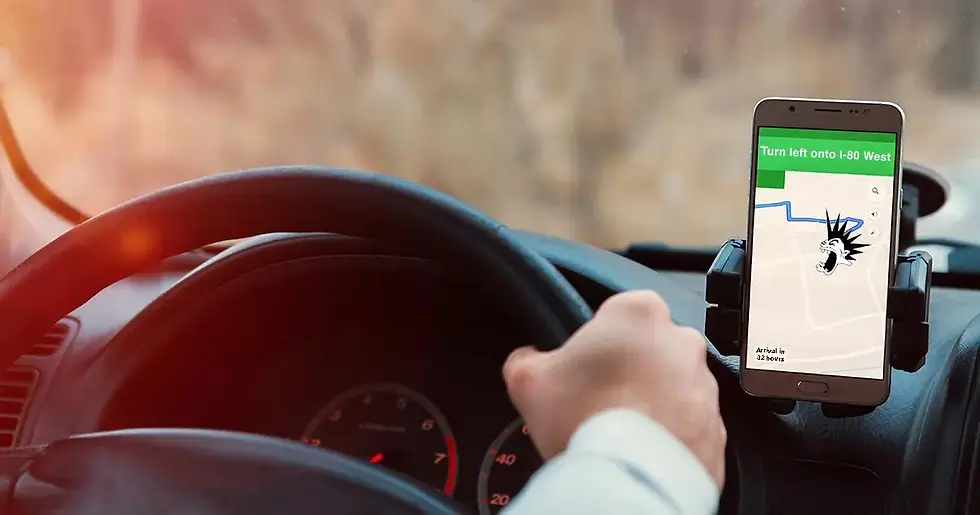
But what if, instead of asking, "Why isn't life following my map?" we occasionally asked, Perhaps: "Given that this is where I am, how do I want to respond?"
Or even: "What matters most to me now?".
Those questions don't erase grief. They don't make loss feel fair. They don't magically transform pain into something positive. But they gently shift our attention from arguing with reality toward deciding how we want to meet it.
And flexibility is where resilience begins. The more we practice coping with the unexpected, the more psychological flexibility we develop.

The Bear Stayed With Me
I don't know how the rest of the bear's afternoon unfolded. Perhaps it wandered back into the woods. Perhaps it found something irresistible in the neighbor's bird feeder.
Perhaps it became the most talked-about resident of the neighborhood for the rest of the day.
What I do know is that I kept thinking about it long after I drove away.
Not because it frightened me. Not because it was extraordinary.
But because, for a few seconds, it gently reminded me that the world doesn't always follow my carefully drawn map. And perhaps that's true of our lives as well.
We can spend enormous energy wishing reality looked more like the picture we had in our minds. Or, every once in a while, we can pause... smile at the unexpected... and make room for the possibility that there is more than one way for a story to unfold.
Even if that story begins with a bear in someone's backyard.
Related Posts
If this story resonated with you, you might also enjoy:
Sometimes the path forward isn't obvious—and that's okay. A reflection on uncertainty, cognitive reappraisal, and learning to move forward without having every answer.
An ordinary trip to the grocery store became a reminder that our minds often make simple decisions much harder than they need to be.
A lighthearted story about dating, pasta, and how quickly our minds jump to conclusions, and how one unexpected conversation became a perfect example of cognitive reframing.
Many people wait until life feels completely overwhelming before reaching out. This article explores the quieter signs that therapy can be helpful long before you're in crisis.
Real change rarely happens overnight. Discover why meaningful growth often comes from small, compassionate shifts rather than becoming a completely different person.


Comments